
Executive Summary
How To Remove Pet Odors From Carpet Permanently requires source removal—not masking—by locating the full urine footprint, treating to the backing/pad depth with proper dwell time, then flushing with high-recovery hot water extraction and drying rapidly to prevent reactivation. If odor returns after complete dry-down, the remaining source is typically contamination in the pad, seams, tack strip, or subfloor and may require targeted subsurface flushing or pad replacement.
Core Insights
- Source Depth Determines Success: Permanent odor removal only happens when urine residues are treated and extracted from the backing and pad (not just surface fibers), because uric salts rehydrate and off-gas with humidity changes.
- Mapping Prevents Missed Reservoirs: UV inspection plus moisture probing is essential to define the true contamination boundary (often 6–18 inches beyond visible spots) and avoid under-treating seams, edges, and perimeter tack strip.
- Sequence Matters (Treat → Dwell → Flush → Dry): Enzymes/oxidizers must be delivered at the correct depth and kept active long enough, then fully recovered via extraction and followed by fast controlled drying to stop bacterial rebound and re-wicking.
How To Remove Pet Odors From Carpet Permanently means extracting urine oils and odor salts from the carpet face yarn, backing, and pad, then neutralizing residue so bacteria cannot re-activate smell. Permanent results require a full-source treatment, not a surface deodorizer. In homes with wall-to-wall carpet over foam pad, pet urine often wicks 6–18 inches beyond the visible spot and binds to latex backing. A reliable deep-clean process starts with UV inspection in a darkened room to map every contaminated zone, then moisture probing to confirm pad saturation. Enzyme treatment must be applied at pad depth, not misted on top, and must dwell long enough for proteins and uric crystals to break down. Hot water extraction must follow with controlled heat and strong vacuum recovery to flush dissolved salts without overwetting the subfloor. In high-humidity areas or during rainy weeks, rapid drying is required, using cross-ventilation and directed airflow to prevent microbial regrowth. If odor returns after the carpet dries, the source is usually pad contamination or urine in tack strip and seams, which requires targeted subsurface flushing or pad replacement in the affected section.
Why pet urine odor “comes back” after you clean it
Pet odor reappears when uric salts and oily residues remain below the carpet surface, then rehydrate and off-gas as humidity changes. Unless the backing, pad, seams, and perimeter tack strip are addressed, the smell can return even when the fibers look clean.
Dog and cat urine is not just a stain—it’s a multi-layer contamination event. After the water component evaporates, insoluble uric acid salts can remain bonded to carpet yarn, latex backing, and foam pad. When indoor moisture rises (coastal fog, rainy weeks, HVAC cycling), those salts partially dissolve again, releasing ammonia-like odor compounds. That’s why a “fresh” scent spray may work for a day, but fails after drying.
- Surface-only cleaning removes visible discoloration, not the pad reservoir.
- Shampoo/encapsulation without flushing can leave residues that attract soil and trap odor.
- Overwetting can push contamination deeper or spread it laterally under the carpet.
Map the full contamination zone before applying any chemistry
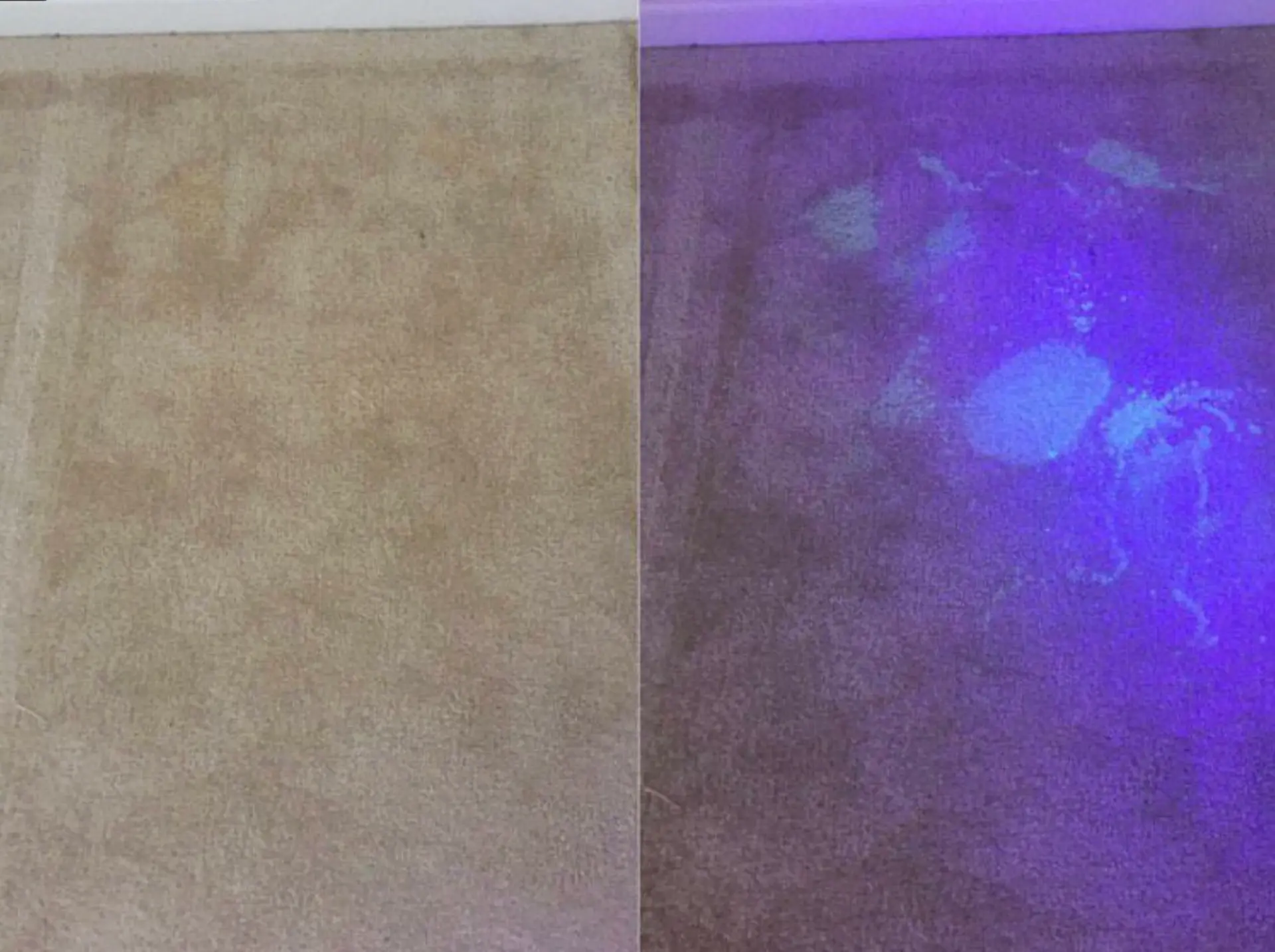
Permanent odor removal starts with accurate location and boundary mapping. UV inspection plus moisture probing prevents under-treatment (missed urine) and over-treatment (unnecessary wetting).
Urine rarely stays inside the visible ring. In tufted carpet over pad, it can wick outward and follow seams, tack strip channels, and low spots in slab/wood subfloor. Correct mapping uses two checks:
- UV/blacklight inspection in a fully darkened room to identify fluorescing zones and edges.
- Moisture measurement (non-penetrating meter plus spot pin checks) to confirm whether the pad/subfloor is involved.
- If the carpet feels stiff or crunchy, that often indicates dried salts in the backing or yarn bundle.
- If odor is strongest at baseboards, contamination may be in the tack strip or perimeter seams.
- If the room smells worse after running the heater or AC, humidity cycling is reactivating residues.
Choose the right treatment strategy based on depth (fiber vs. backing vs. pad)
The correct fix depends on where the urine is: on the fiber, in the backing, in the pad, or in the subfloor. Each layer requires different access and recovery methods to avoid spreading contamination.
Use this decision logic:
- Fiber-only contamination: localized enzymatic treatment + controlled hot water extraction.
- Backing + pad involvement: subsurface injection (pad depth), dwell, then high-vacuum extraction and rapid drying.
- Subfloor contamination (wood or slab): pull-back, pad replacement, and sealed subfloor when needed.
When odor persists after correct cleaning and drying, the most common root cause is pad reservoir or contamination in seams/tack strip, not “bad enzymes.”
Step-by-step: deep pet urine deodorization that targets the source
A permanent process follows a strict sequence: locate, saturate to the contamination depth with the correct agent, dwell, flush/extract, then dry fast. Skipping dwell time or extraction is the fastest way to leave odor salts behind.
- Dry soil removal: HEPA vacuum to remove particulate that blocks chemistry and wicks moisture.
- Pre-test carpet and dye stability: especially on wool, natural dyes, and some nylon blends.
- Apply urine treatment at depth: use a subsurface tool or controlled injection so solution reaches the pad/backing (not just mist on top).
- Dwell time: keep the area damp (not flooded) long enough for enzymes to break down proteins and urea residues; premature drying reduces effectiveness.
- Hot water extraction (HWE): flush dissolved contamination out with controlled heat and high vacuum recovery.
- Neutralize and rinse: apply a fiber-safe rinse to reduce residue and stabilize pH.
- Rapid drying protocol: air movers aimed across the carpet, dehumidification if needed, and HVAC circulation.
- Do not steam “blast” urine areas without prior treatment—heat can volatilize odor and set some residues deeper.
- Do not use fragranced deodorizers as the primary solution; they mask rather than remove.
- Avoid high-alkaline cleaners unless you can thoroughly rinse; alkalinity can intensify ammonia odor.
What products work (and what fails) for urine odor in carpet
Enzymes and oxidizers work when they contact the contamination at the correct concentration and depth, followed by extraction. Many DIY failures happen because the chemistry never reaches the pad reservoir or is not recovered from the carpet.
Effective categories and correct use cases:
- Enzyme digesters: best for fresh-to-moderate organic residues; require dwell time and moisture to remain active.
- Oxidizers (e.g., hydrogen peroxide-based): useful for odor molecules and some discoloration; must be color-tested and applied per label instructions.
- Acidic rinses: used to stabilize pH and reduce residues after treatment and extraction.
Methods that commonly fail for permanent odor removal:
- Vinegar-only sprays: may temporarily reduce odor perception but do not remove uric salts from pad/backing.
- Baking soda “carpet snow”: can absorb some surface odor but cannot dissolve and extract salts below the carpet.
- Fragrance bombs and aerosols: add VOC fragrance on top of contamination; odor returns when fragrance dissipates.
HTML data table: practical standards that determine whether odor removal will last
This table summarizes the metrics that control outcomes: contamination depth, application method, extraction, and drying. Following these specifications reduces re-wicking and prevents microbial regrowth.
| Feature / Metric | Specifications | Local Guidelines |
|---|---|---|
| Contamination mapping | UV inspection in dark + moisture meter confirmation at suspected zones (center, edges, seams) | In coastal/humid weeks, map broader perimeters because salts reactivate with humidity swings |
| Treatment depth | Apply urine agent to backing/pad depth using subsurface delivery; top-misting is insufficient | For wall-to-wall carpet over foam pad, expect wicking beyond visible area and treat the full affected footprint |
| Dwell time control | Keep treatment active (damp, not flooded) long enough to break down proteins/urea; do not let it flash-dry | Use airflow only after dwell; premature fan placement can dry chemistry before it works |
| Extraction & recovery | Hot water extraction with strong vacuum to remove dissolved salts; multiple dry passes reduce residual moisture | Avoid overwetting on upper floors or near baseboards to prevent seepage into subfloor and wall plates |
| Drying speed | Cross-ventilation + directed air movers; dehumidification when ambient RH is elevated | During marine layer/rainy periods, prioritize mechanical drying to prevent microbial amplification of odor |
When you must replace pad (and when you don’t)
Pad replacement is required when contamination is widespread, repeatedly soaked, or bonded into pad and tack strip where extraction cannot fully recover it. If the pad is only lightly affected, subsurface flushing and strong recovery can be sufficient.
Replace pad in the affected section when any of the following are true:
- Repeated accidents in the same area (multiple saturation cycles).
- Odor persists after correct deep extraction and full dry-down (not just “same day”).
- Urine reached tack strip or under baseboards (perimeter odor strongest).
- Wood subfloor has absorbed urine and continues to off-gas despite cleaning.
Targeted pad replacement typically involves pulling back the carpet, cutting out the contaminated pad section, treating/sealing the subfloor when needed, then re-stretching and re-seaming correctly so the repaired area does not ripple.
High-risk zones people miss: seams, tack strip, and transitions
Persistent odor frequently originates at carpet edges and construction details, not the center of the stain. These areas hold urine because liquids follow gravity, gaps, and capillary paths.
- Seams: urine can travel along seam tape channels and reappear as odor lines.
- Tack strip: wood strip absorbs urine and sits in a low-airflow zone where odor lingers.
- Doorways and transitions: repeated pet traffic increases re-wetting and drives residues deeper.
- Furniture legs/corners: pets often mark vertical surfaces; urine runs down to perimeter pad.
Correct remediation uses edge tools and controlled subsurface flushing, followed by aggressive vacuum recovery and directed airflow along baseboards—not just in the middle of the room.
DIY spot treatment protocol for fresh accidents (first 24 hours)
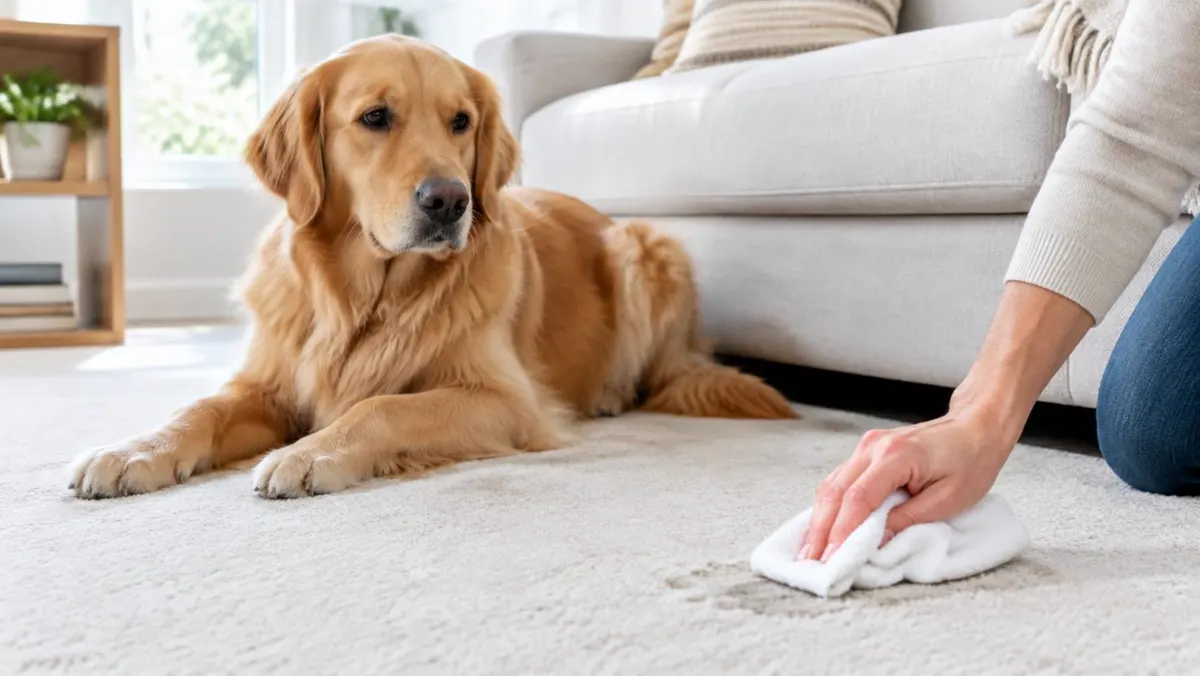
Fast response reduces how far urine wicks into pad and backing. The goal is maximum absorption first, then correct rinsing and drying—not rubbing and masking.
- Blot immediately: use white towels; stand and press to absorb (do not scrub).
- Cold water rinse and blot: small amounts, repeated blotting to dilute.
- Apply enzyme cleaner: enough to reach the depth of the spill; cover with plastic to prevent evaporation and allow dwell.
- Blot/extract: a wet/dry vacuum improves recovery if used correctly.
- Dry fast: fans blowing across the area, not straight down; lift a corner edge slightly if safe to speed pad drying.
- Avoid heat sources directly on the spot during the first phase; heat can intensify odor release.
- If discoloration remains after odor is solved, treat stain separately—do not keep flooding the area.
When professional equipment becomes necessary
Professional intervention is needed when contamination reaches the pad/subfloor, affects multiple locations, or returns after DIY attempts. Proper subsurface delivery tools, high-CFM vacuum recovery, and controlled rinsing prevent re-wicking and residue.
If you are dealing with recurring odor, multiple pet spots, or a move-out inspection, schedule a deep extraction service designed for urine contamination. A dedicated Odor Removal in San Diego appointment is typically the correct pathway when you need source removal rather than fragrance masking.
For added context on methods and why extraction matters, see what hot water extraction carpet cleaning is and how it physically flushes dissolved residues out of the carpet system.
Preventing repeat odor after remediation (behavior + maintenance)
Long-term results require preventing re-soiling and stopping new marking behavior. Even a perfect deep clean can be undone by repeat accidents in the same area.
- Block access during dry-down: pets revisit damp spots because residual scent cues remain stronger when moist.
- Use washable runners in known “target” lanes until behavior stabilizes.
- Maintain with neutral rinsing extraction on a schedule appropriate to pets and traffic.
- Address marking triggers: new pets, outdoor animal presence, litter/box issues, or stress changes.
It also helps to understand the broader mechanics of carpet cleaning methods—especially the difference between surface cleaning and true rinse-and-recovery—so maintenance choices don’t reintroduce residues that hold odor.
Zero-guesswork wrap-up: what makes pet odor removal truly permanent
Permanent pet odor removal is a measurable process: identify every contaminated zone, treat at pad depth, allow proper dwell, flush with high-recovery extraction, and dry rapidly. When odor returns after full drying, the remaining source is almost always in pad, seams, tack strip, or subfloor—not on the carpet surface.
- Use UV + moisture verification to prevent missed spots.
- Deliver enzymes/oxidizers to the depth of contamination, not as a light top spray.
- Rely on extraction to remove dissolved salts rather than leaving them in place.
- Dry fast with directed airflow and humidity control to stop microbial rebound.
- Escalate to targeted pad replacement when the reservoir cannot be recovered.
Frequently Asked Questions
Stop the “It Smells Fine… Until It Doesn’t” Cycle
Pet urine odor doesn’t “come back” because your nose is being dramatic—it comes back because the source was never removed. Most DIY spot cleaners and off-the-shelf deodorizers only touch the surface fibers while urine oils and uric salts stay locked in the backing, pad, seams, and tack strip… waiting for the next humidity swing or HVAC cycle to reactivate.
And here’s the part most people don’t realize until it’s too late: the wrong approach can actually make it worse. Overwetting can push contamination deeper and spread it 6–18 inches beyond what you can see. Heat without proper treatment can intensify off-gassing. Encapsulation and shampoos can leave residues that trap odor and attract soil. Then you’re not just dealing with smell—you’re dealing with wicking, recurring spots, longer dry times, and a pad reservoir that never truly resets.
If you want permanent results, you need a process that’s built for source removal: accurate UV + moisture mapping, correct subsurface delivery to pad depth, proper dwell time, high-recovery hot water extraction, and fast controlled drying so bacteria doesn’t get a second chance.
Book a professional pet odor treatment that targets the source—not the symptom—by contacting SoCal Steam Carpet.
Leave a Reply
You must be logged in to post a comment.