



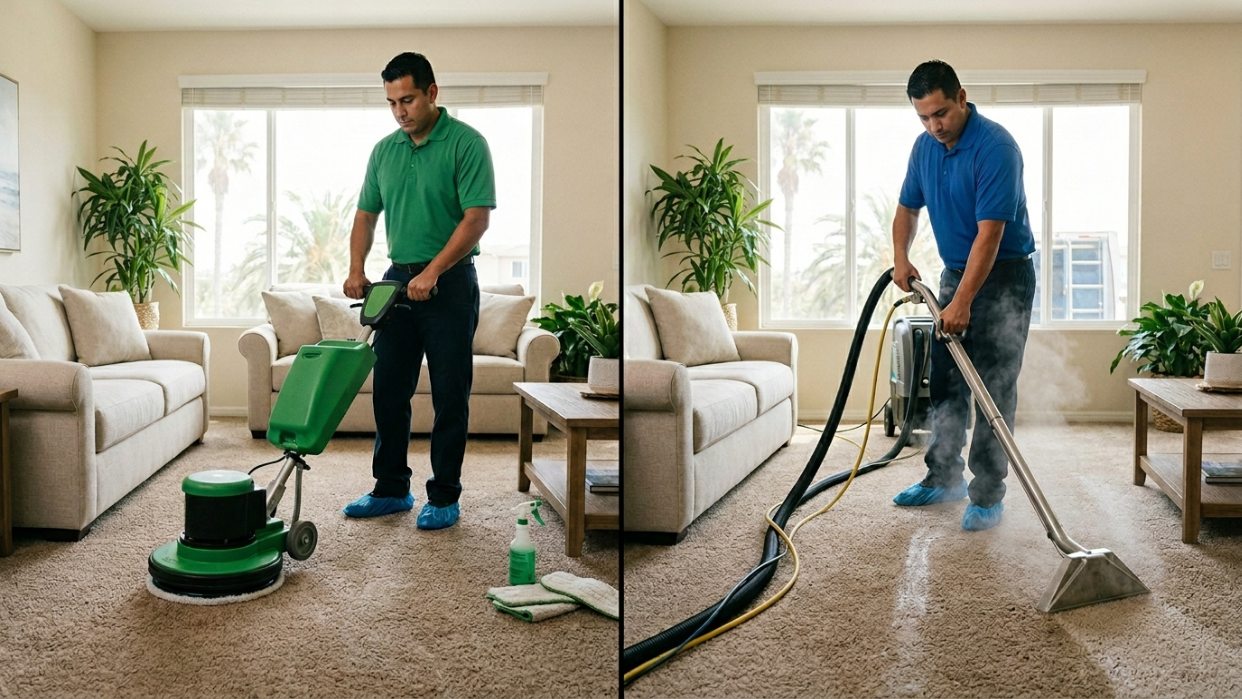
 For most San Diego homes — especially those with children, pets, or allergy sufferers — eco-friendly carpet cleaning is the better all-around choice, while traditional cleaning still wins for severe, set-in stains and heavy commercial soiling on a tight budget. That’s the short answer. The longer one depends on your carpet, your household, and how much you weigh long-term safety against upfront cost.
This guide breaks down Eco-Friendly Carpet Cleaning vs Traditional Cleaning across every factor that actually matters: what each method is, how it works, what it costs, and where each one shines. By the end, you’ll know exactly which approach fits your home in San Diego’s coastal, allergy-prone climate — no sales pressure, just a clear framework for deciding.
Understanding Eco-Friendly Carpet Cleaning
Eco-friendly carpet cleaning uses biodegradable, plant-derived, and certified non-toxic solutions — often paired with low-moisture or hot-water-extraction methods that minimize water and chemical use. Instead of harsh detergents, optical brighteners, or solvent-heavy spotters, green cleaners rely on enzymes, citrus, and oxygen-based agents that break down soil without leaving a chemical residue behind.
How it works: Most reputable providers combine a Green Seal or EPA Safer Choice–certified solution with professional hot-water extraction. The certified solution lifts dirt; the extraction equipment flushes it out and recovers the bulk of the moisture. Because the cleaning agents are gentler, these eco-friendly carpet cleaning services lean on equipment quality and technician skill rather than chemical strength.
Typical costs: Expect roughly $35–$70 per room or $0.30–$0.60 per square foot — generally a modest premium of 10–20% over conventional cleaning, reflecting the cost of certified products and specialized training.
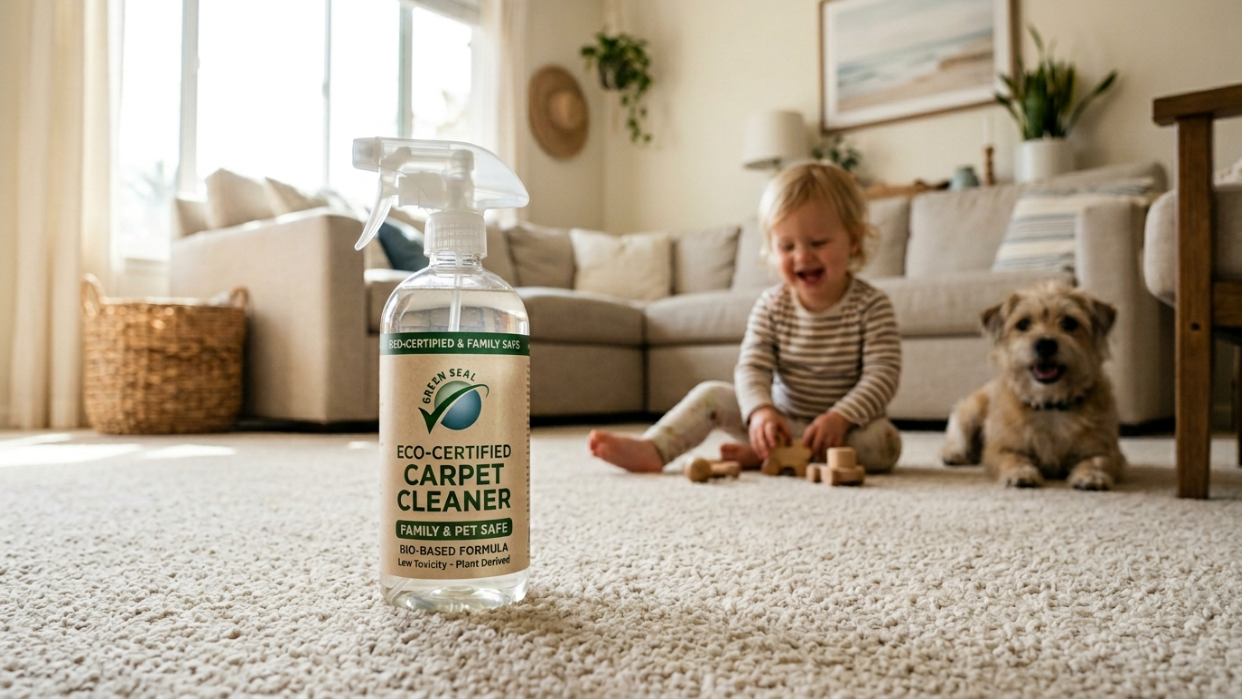 Core benefits: Lower indoor VOC exposure, fewer residues that can attract dirt back into fibers, and water-use efficiency that aligns well with California’s ongoing conservation rules. For San Diego households dealing with marine-layer humidity and seasonal allergens, a residue-free finish can help carpets stay fresher between cleanings — part of why so many homeowners choose eco-friendly carpet cleaning in the first place.
Ideal use cases: Homes with infants, pets, asthma or allergy sufferers, environmentally conscious owners, and anyone sensitive to chemical odors. It’s also a strong fit for newer, delicate, or wool carpets where harsh detergents risk fiber damage — and the same gentle chemistry makes for safe carpet cleaning solutions for pets.
Understanding Traditional Carpet Cleaning
Traditional carpet cleaning relies on conventional, often more aggressive detergents and solvents engineered to dissolve stubborn soil and stains quickly. It typically uses high-heat steam cleaning (hot-water extraction) or, in commercial settings, bonnet and shampoo methods that prioritize raw cleaning power and speed.
How it works: A strong detergent is worked into the carpet, then extracted with hot water under pressure. The chemistry is formulated to cut through grease, traffic lane soil, and set-in stains with minimal dwell time. Some traditional spotters use solvents that are highly effective on oil-based stains but can leave a residue or odor if not thoroughly rinsed — one of the trade-offs worth understanding when you see how the main carpet cleaning methods compare.
Typical costs: Generally $25–$50 per room or $0.25–$0.45 per square foot, making it the more budget-friendly option upfront — particularly for large square footage or commercial jobs. For a fuller breakdown, see what professional steam carpet cleaning typically costs.
Core benefits: Maximum stain-fighting strength, fast results, and lower upfront pricing. For deeply soiled rentals, post-construction cleanups, or high-traffic commercial floors, conventional chemistry often clears in one pass what a gentler method needs two for.
Ideal use cases: Heavily soiled carpets, move-out cleans, commercial spaces, and severe oil- or grease-based stains where cleaning power outranks chemical sensitivity concerns. If no one in the home has allergies or chemical sensitivities and the budget is tight, traditional cleaning remains a perfectly reasonable choice.
Side-by-Side Comparison
| Attribute | Eco-Friendly Carpet Cleaning | Traditional Cleaning |
|---|---|---|
| Upfront Cost | $35–$70/room (10–20% premium) | $25–$50/room (budget-friendly) |
| Cleaning Power | Strong on everyday soil; may need a second pass on severe stains | Maximum strength on set-in & oil-based stains |
| Indoor Air & Safety | Low VOCs, certified non-toxic, pet- and child-safe | Stronger chemical odors and residues possible |
| Water & Chemical Use | Lower — aligns with CA conservation rules | Higher water and detergent volume |
| Drying Time | Often faster with low-moisture options | Can be longer with high-moisture steam |
| Residue & Re-soiling | Minimal residue, slower re-soiling | Residue can attract dirt faster if under-rinsed |
| Best For | Families, pets, allergies, wool/delicate carpets | Commercial, move-outs, severe staining, tight budgets |
Pros and Cons Breakdown
Pros of Eco-Friendly Carpet Cleaning
- Safer indoor air: Certified low-VOC solutions reduce the chemical fumes that can linger in San Diego homes kept closed against the afternoon marine layer.
- Gentle on fibers: Less risk of damaging wool, delicate, or newer carpets, helping protect your flooring investment.
- Pet- and child-friendly: Non-toxic residues mean less worry when little ones and pets are back on the carpet sooner.
- Water-efficient: Lower water use supports compliance with California’s conservation expectations.
- Slower re-soiling: A residue-free finish helps carpets stay cleaner longer between visits.
Cons of Eco-Friendly Carpet Cleaning
- Higher upfront cost: Certified products and training add a modest premium.
- May need extra passes: Very severe or oil-based stains can require additional treatment.
- Quality varies: “Green” is unregulated marketing on its own — results depend on genuine certifications and technician skill.
Pros of Traditional Cleaning
- Lower upfront price: The budget-friendly choice, especially at scale.
- Maximum stain power: Excels on set-in, greasy, and high-traffic soiling.
- Fast, proven results: Often clears tough jobs in a single pass.
- Widely available: Nearly every provider offers it.
Cons of Traditional Cleaning
- Chemical exposure: Stronger detergents and solvents can raise indoor VOCs and odors.
- Residue risk: Under-rinsed detergent can attract dirt back faster.
- Harsher on delicate fibers: Higher risk to wool and specialty carpets.
- Higher water use: Less aligned with regional conservation priorities.
Which Option Is Better? The Ultimate Showdown
When you weigh Eco-Friendly Carpet Cleaning vs Traditional Cleaning purely on upfront cost, traditional wins — it’s typically 10–20% cheaper and unbeatable on severe staining. But cost-per-clean isn’t the whole picture. Eco-friendly methods often leave less residue, which can slow re-soiling and stretch the time between professional visits, narrowing the long-term cost gap.
Here’s the practical breakdown:
Choose eco-friendly carpet cleaning if your priority is a safe, low-chemical home — you have kids, pets, allergy or asthma sufferers, or wool and delicate carpets. In a city like San Diego, where homes stay sealed against humidity and residents lean heavily toward sustainable living, the air-quality and water-efficiency benefits carry real weight. The modest premium buys peace of mind and fiber protection.
Choose traditional cleaning if you’re tackling a heavily soiled rental, a commercial space, a move-out clean, or severe oil-based stains on a tight budget — and no one in the household has chemical sensitivities. When raw cleaning power and lowest upfront price are the deciding factors, conventional chemistry delivers, though deep set-in odor removal sometimes calls for a dedicated treatment regardless of which method you start with. If you’re still weighing your options, it helps to see the best carpet cleaning methods explained side by side.
The verdict for most San Diego homeowners: Eco-friendly comes out ahead. The combination of low-toxicity safety, water efficiency that fits California regulations, and slower re-soiling makes it the smarter long-term choice for everyday residential carpets — with traditional cleaning held in reserve for the toughest, dirtiest jobs. Whichever you choose, isolated trouble areas can be handled separately with targeted stain and spot removal, and many San Diego households round out a visit by adding upholstery cleaning or tile, grout and stone cleaning to refresh the whole home at once.
Get a Free San Diego Carpet Cleaning Consultation
Still deciding between Eco-Friendly Carpet Cleaning vs Traditional Cleaning for your home? Our San Diego team is happy to walk you through the right method for your carpet, your household, and your budget — no pressure, just honest guidance. Request your free quote or book a carpet cleaning consultation in San Diego and we’ll recommend the approach that fits your space.
Conclusion & Recommendation
For the typical San Diego household, eco-friendly carpet cleaning is the recommended choice — it delivers a safe, low-chemical, water-efficient clean that protects both your family and your carpet fibers, while staying aligned with California’s conservation priorities. Traditional cleaning remains the smart pick for severe staining, commercial floors, and budget-driven move-out jobs. Match the method to the job, and you’ll get the cleanest result without compromise.
Frequently Asked Questions
Is eco-friendly carpet cleaning as effective as traditional cleaning?
Is eco-friendly carpet cleaning as effective as traditional cleaning?
For everyday soil and most household stains, yes — certified green solutions paired with professional hot-water extraction clean very effectively. Traditional cleaning may still have an edge on severe, set-in, or oil-based stains, which can occasionally require an extra pass with green methods.
Does eco-friendly carpet cleaning cost more in San Diego?
Does eco-friendly carpet cleaning cost more in San Diego?
Typically a modest 10–20% premium over traditional cleaning, reflecting certified products and specialized training. Because residue-free cleaning can slow re-soiling, the long-term cost difference is often smaller than it first appears.
Is eco-friendly carpet cleaning safe for pets and children?
Is eco-friendly carpet cleaning safe for pets and children?
That’s one of its biggest advantages. Certified non-toxic, low-VOC solutions leave minimal residue, so pets and children can return to the carpet sooner with less concern about chemical exposure.
How long do carpets take to dry after each method?
How long do carpets take to dry after each method?
Eco-friendly low-moisture options often dry faster, sometimes within a few hours. High-moisture traditional steam cleaning can take longer, especially during San Diego’s humid marine-layer mornings when ventilation is reduced.
What does “eco-friendly” actually mean for carpet cleaning?
What does “eco-friendly” actually mean for carpet cleaning?
Look for recognized certifications like Green Seal or EPA Safer Choice. On its own, “green” is unregulated marketing — genuine eco-friendly cleaning combines certified biodegradable solutions with water-efficient, low-residue methods.
Which method is better for allergies and asthma?
Which method is better for allergies and asthma?
Eco-friendly cleaning is generally preferred, as low-VOC, residue-free solutions help reduce the airborne irritants and chemical fumes that can aggravate allergies and asthma in closed-up San Diego homes.
Can traditional cleaning damage my carpet?
Can traditional cleaning damage my carpet?
Harsher detergents and solvents can be tougher on wool and delicate fibers, and under-rinsed residue may attract dirt faster. For specialty or newer carpets, a gentler eco-friendly approach is usually safer.
How often should I have my carpets professionally cleaned in San Diego?
How often should I have my carpets professionally cleaned in San Diego?
Most homes benefit from a professional cleaning every 6–12 months, more often with pets, kids, or high traffic. Coastal humidity and seasonal allergens can make regular cleaning especially worthwhile in San Diego.