



Executive Summary
Carpet odor removal specialists eliminate recurring carpet odors—especially pet urine—by locating the true contamination source and neutralizing it at the correct depth (carpet, pad, and sometimes subfloor). Lasting results come from urine-specific chemistry, thorough extraction, and controlled drying rather than fragrance-based masking.
Key Takeaways
- Source removal beats masking: Professionals focus on eliminating the odor source (urine residues/crystals), not covering it with deodorizer fragrances.
- Depth determines whether the smell returns: Persistent odors usually indicate saturation into the pad, tack strip, or subfloor—so surface-only cleaning won’t hold.
- “Reactivation” is driven by humidity and re-wetting: Dried urine salts can rehydrate and release odor again, which is why neutralization plus extraction and drying are essential.
- Detection tools find what the eye can’t: UV/black light inspection, moisture meters, and targeted sniff testing help map hidden contamination beyond visible staining.
- Proper chemistry + drying control drives outcomes: Enzymes often work best on fresh urine, oxidizers on older/heavier contamination, and both approaches rely on thorough extraction and fast drying to prevent rebound.
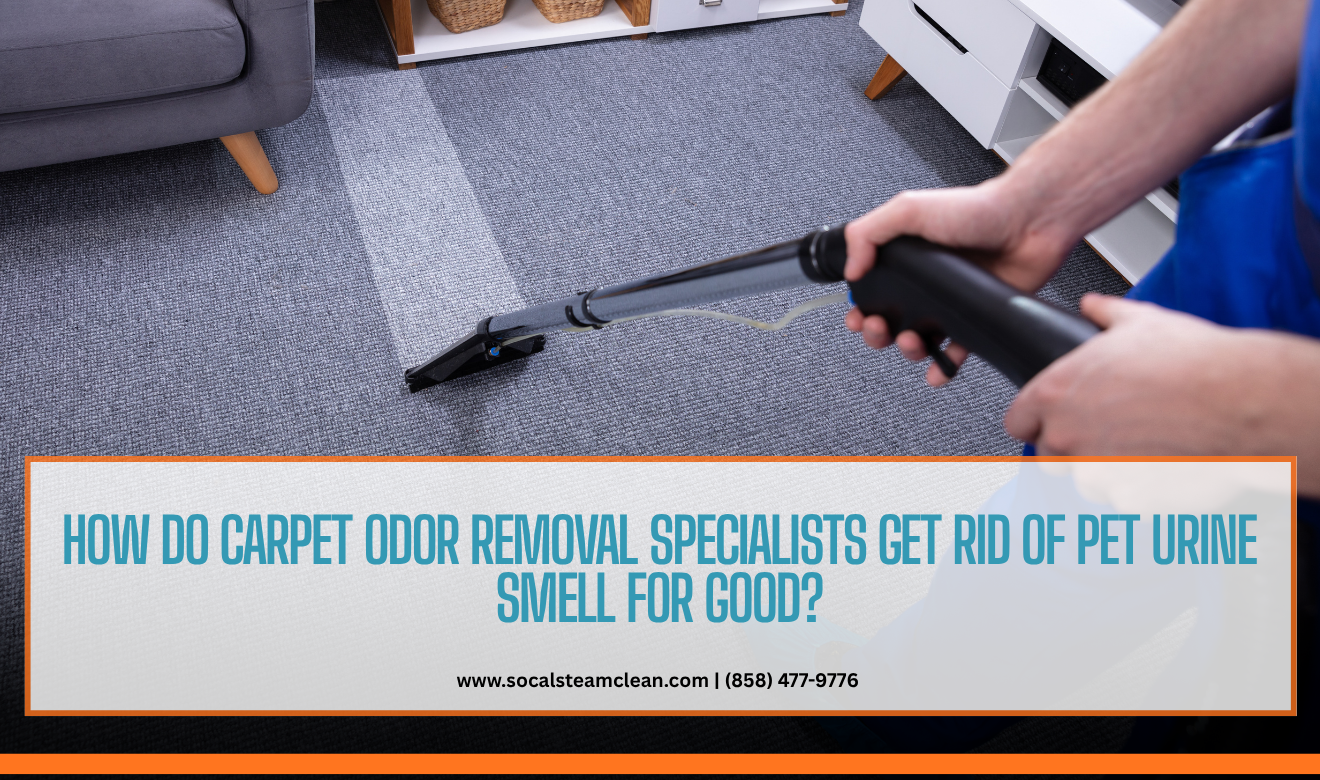
Carpet odor removal specialists get rid of pet urine smell for good by finding the urine source, breaking down the odor-causing crystals, and treating both the carpet and the padding beneath it. They don’t just mask the smell with fragrance—they neutralize it so it can’t “wake up” again when humidity rises. For example, they may use a UV light to spot old urine that isn’t visible, then apply an enzyme-based or oxidizing treatment that targets the urine compounds directly. If the urine has soaked through, they’ll treat the subfloor area too, because cleaning only the surface can leave a lingering smell that comes back after steam cleaning or on a warm day.
What carpet odor removal specialists actually do (and why it works)
When homeowners say “the smell keeps coming back,” it’s usually because urine (or another odor source) has moved beyond the carpet fibers into the pad, tack strip, or subfloor. Carpet odor removal specialists focus on complete odor source removal—not “cover-up.” That typically means identifying contamination, choosing the right chemistry for the odor type, and fully drying the area so residues don’t continue to off-gas.
Most successful professional treatments follow a simple logic:
- Find the source (even if it’s old or invisible)
- Break down or oxidize odor compounds (not just perfume them)
- Reach the pad/subfloor if saturation occurred
- Extract and dry thoroughly to prevent reactivation
For context, the Institute of Inspection Cleaning and Restoration Certification (IICRC) describes professional carpet cleaning methods and standards that emphasize soil/contaminant removal and controlled drying—principles that matter just as much for odor work as for appearance cleaning. You can also read a general overview of carpet cleaning methods and why extraction and drying affect results.
How to tell if the smell is in the carpet, the pad, or the subfloor
Here’s a quick way to narrow down where the odor is living. Carpet odor removal specialists do this assessment quickly on-site, but you can use these clues before you schedule service.
Signs the odor is mostly in the carpet fibers
- The smell is strongest at nose level right over the carpet surface.
- You recently cleaned the area and it improved, but didn’t fully resolve.
- The stain is small and you caught it quickly (minutes to a few hours).
Signs the odor has soaked into the pad
- Odor intensifies on humid days or after you run a humidifier.
- The smell returns after steam cleaning or shampooing.
- The area feels slightly “crunchy” or stiff (dried urine salts/crystals).
Signs the odor reached the subfloor (wood or concrete)
- The smell persists even after repeated cleaning attempts.
- You notice odor at the edges/baseboards or near tack strips.
- Pets repeatedly re-soil the same location (they’re following residual odor).
Why pet urine odor “wakes up” again
That “it was gone, then it came back” experience is common—and explainable. Dried urine residues can rehydrate when humidity rises. Once rehydrated, they can release odor again, especially in warm rooms or during rainy seasons.
Carpet odor removal specialists prevent this rebound by doing two things that DIY attempts often miss:
- Neutralization at depth: treating the pad/subfloor if needed, not only the visible carpet surface
- Rinse/extraction and drying: removing dissolved residues and moisture so odor compounds aren’t left behind
How carpet odor removal specialists find hidden urine spots
Locating contamination is half the battle. Old urine may not show as a stain, especially on darker carpet, patterned carpet, or after previous cleaning.
Common detection tools and methods
- UV/black light inspection: helps reveal fluorescent residues from urine and other biological materials
- Moisture meters: can indicate damp pad/subfloor areas where contamination may be present
- Target sniff testing: done close to the carpet, along edges, and around furniture legs
- History mapping: pros ask where pets sleep, mark, or repeatedly return—often where contamination concentrates
Once mapped, carpet odor removal specialists can treat the full “contamination footprint,” which is usually larger than the visible spot.
What treatments are used to neutralize carpet odors (not mask them)
There isn’t one universal chemical that fixes every odor. Effective carpet odor removal specialists choose the chemistry based on the odor source and the carpet construction. Below is a practical breakdown.
| Odor source | Treatment approach | Why it works |
|---|---|---|
| Pet urine (fresh) | Enzyme/bacteria digesters + extraction + drying | Breaks down urine components before they crystallize; removes residues |
| Pet urine (old/heavy) | Oxidizers (e.g., peroxide-based) or specialty urine decontamination, sometimes pad treatment or replacement | Targets stubborn odor compounds/salts that rehydrate and smell later |
| Smoke/organic odors | Deep cleaning + adsorption/deodorizing agents; sometimes controlled ozone/hydroxyl by trained pros | Removes embedded particulate and neutralizes volatile odor molecules |
| Mildew/musty odor | Moisture source correction + antimicrobial cleaning + fast drying/dehumidification | Odor won’t stop unless moisture is controlled; drying prevents regrowth |
Two important notes:
- Fragrance-only deodorizers are temporary. They can make a room smell “clean” while the source remains.
- Over-wetting can backfire. Too much DIY liquid can drive contamination deeper—exactly what carpet odor removal specialists try to avoid.
What to do immediately after an accident (to improve professional results later)
If you catch urine quickly, you can reduce how far it travels and make it easier for carpet odor removal specialists to fully neutralize it.
Fast response steps (safe, practical)
- Blot—don’t rub: Use white towels and firm pressure to pull liquid up.
- Rinse lightly with cool water: A small amount helps dilute; avoid soaking the area.
- Blot again: Repeat until towels come up mostly dry.
- Apply an enzyme cleaner correctly: Follow label directions; many require dwell time and must reach the same depth as the urine.
- Dry thoroughly: Use a fan; avoid sealing moisture under plastic for long periods unless the product specifically instructs it.
Avoid ammonia-based cleaners—urine already contains ammonia compounds, and the smell can encourage repeat marking.
When odor removal needs more than surface cleaning
Carpet odor removal specialists often recommend deeper steps when the contamination is extensive. These are the scenarios where “just cleaning the carpet” usually won’t hold.
Common “beyond the surface” scenarios
- Repeated accidents in the same area (common near doors, litter boxes, or pet beds)
- Large-volume events (senior pets, sick pets, or overnight saturation)
- Carpet over wood subfloor where urine can soak and linger in seams/grain
- Carpet installed on concrete where urine can migrate into cracks or along edges
In these cases, a professional may recommend a targeted pad treatment, a “lift and treat” approach, sealing localized subfloor sections, or partial pad replacement. The goal is the same: remove or isolate the odor source so it can’t volatilize again.
Cost: what influences professional carpet odor removal pricing
Pricing varies widely because odor jobs are not one-size-fits-all. Carpet odor removal specialists typically base cost on severity, square footage, and how deep they must treat (carpet only vs. pad/subfloor).
Main factors that raise or lower cost
- Size of affected area: one spot vs. multiple rooms
- Depth of contamination: surface only vs. pad/subfloor involvement
- Type of odor: urine, smoke, mildew, food, etc.
- Detection time: extensive UV mapping in multiple rooms
- Drying requirements: whether air movers/dehumidification are needed
Tip: If you’re combining services, scheduling odor work alongside a deep extraction can be more effective, because extraction helps remove dissolved residues after treatment. If you’re looking for a related service, consider professional Odor Removal in San Diego as a dedicated option rather than a quick add-on deodorizer.
How long it takes for the odor to be fully gone
Many odors improve immediately after treatment, but “fully gone” depends on drying and whether the source was completely addressed.
Typical timelines
- Light, recent urine: often resolved the same day once dry
- Moderate, older spots: may take 24–48 hours to confirm once fully dried
- Heavy saturation: may require multiple steps (including subfloor work), so confirmation can take several days
Carpet odor removal specialists will often advise you to evaluate results after the area is dry and the home is closed up for a few hours—because air movement can temporarily “hide” what humidity later reveals.
Why DIY deodorizing powders and home remedies often fail
DIY can help with light odors, but it frequently struggles with urine that has penetrated below the carpet. Some DIY methods create new problems that carpet odor removal specialists end up having to correct.
Common pitfalls
- Baking soda overload: can get trapped in carpet backing and is difficult to fully vacuum out, especially in plush carpet.
- Vinegar misuse: may reduce odor short-term but doesn’t necessarily remove urine salts from pad/subfloor.
- Over-wetting with rental machines: can push contamination deeper and leave the pad damp, contributing to musty smells.
- Fragrance sprays: mask odors temporarily, then fade—leaving the original odor intact.
How to choose carpet odor removal specialists (quick checklist)
You’ll get better results when the technician treats odor removal as contamination removal, not a fragrance add-on. Use this checklist when you call.
Questions that indicate real expertise
- “Do you use UV inspection or another method to locate all affected areas?”
- “Will you treat the pad/subfloor if the urine has soaked through?”
- “Which approach do you use for urine—enzyme, oxidation, or both—and why?”
- “How do you ensure the area is thoroughly dried?”
- “Do you follow recognized industry standards (like IICRC methods)?”
If you want to learn more about deep cleaning methods that often pair with odor treatment, this guide on hot water extraction carpet cleaning explains why thorough extraction and controlled drying can make a noticeable difference.
Case examples: what “successful odor removal” looks like in real homes
These examples reflect common, well-documented patterns that carpet odor removal specialists see—especially the role humidity and depth play in odor rebound.
Example 1: “Smells fine until it rains”
- Situation: A living room smells normal most days, but urine odor returns during humid weather.
- What’s happening: Dried urine residues in the pad rehydrate when humidity rises.
- What typically fixes it: UV mapping + saturation-level treatment to reach pad + extraction + fast drying. If contamination is widespread, pad replacement may be recommended.
Example 2: “We cleaned it twice—still smells”
- Situation: DIY cleaning removes the stain, but odor persists.
- What’s happening: Cleaning removed surface soil but left urine salts/crystals below the backing.
- What typically fixes it: A urine-specific treatment (enzyme and/or oxidation) followed by thorough extraction. Carpet odor removal specialists may also treat edges/tack strip zones where urine wicks.
Trust signals: credentials and standards that matter
Odor problems are part chemistry, part material science, and part drying science. The most reliable carpet odor removal specialists lean on recognized training and standards rather than “miracle sprays.”
- IICRC-aligned methods: IICRC is a widely recognized certification body for cleaning and restoration; its standards emphasize proper cleaning steps, safety, and drying principles.
- Clear process documentation: reputable pros explain inspection, treatment selection, extraction, and drying—not just “we deodorize.”
- Safety-aware application: correct dilution, dwell time, ventilation, and material compatibility checks (especially on wool or specialty fibers).
Fresh Floors, Finally: the lasting fix for stubborn pet odors
If you’re dealing with recurring pet smells, the fastest path to real relief is treating odor at the source—carpet, pad, and subfloor when needed—then extracting and drying correctly. That’s the difference between a home that smells “covered up” and one that stays truly clean through humidity, heat, and future cleanings.
When carpet odor removal specialists use proper detection, urine-specific chemistry, and controlled drying, the odor doesn’t just fade—it’s neutralized so it can’t rebound. If your situation involves repeated accidents or lingering odor after cleaning, it’s a strong signal the contamination is deeper than the surface and needs professional-level source removal.
Carpet odor removal specialists can also help you prevent repeat issues by identifying hotspots, recommending protective steps, and ensuring the underlying materials (like pad and subfloor) aren’t quietly holding onto odor.
Frequently Asked Questions
Stop the “It Came Back” Smell—Get Real Odor Removal That Actually Sticks
If pet urine odor keeps reappearing after you clean, that’s a strong sign it’s not just in the carpet—it’s in the pad or even the subfloor. SoCal Steam Carpet specializes in true source removal: UV spotting to find hidden contamination, urine-specific treatments to break down crystals, and the deep extraction + controlled drying it takes to keep odors from “waking up” again. Want your home to smell clean on humid days, warm days, and every day in between? Reach out and get a targeted game plan for your exact situation.
Leave a Reply
You must be logged in to post a comment.